

#1 - The Swiss Franc
First issue of the Game Of Francs article series: a deep dive into the Swiss Franc.
by Game Of Francs Research Team
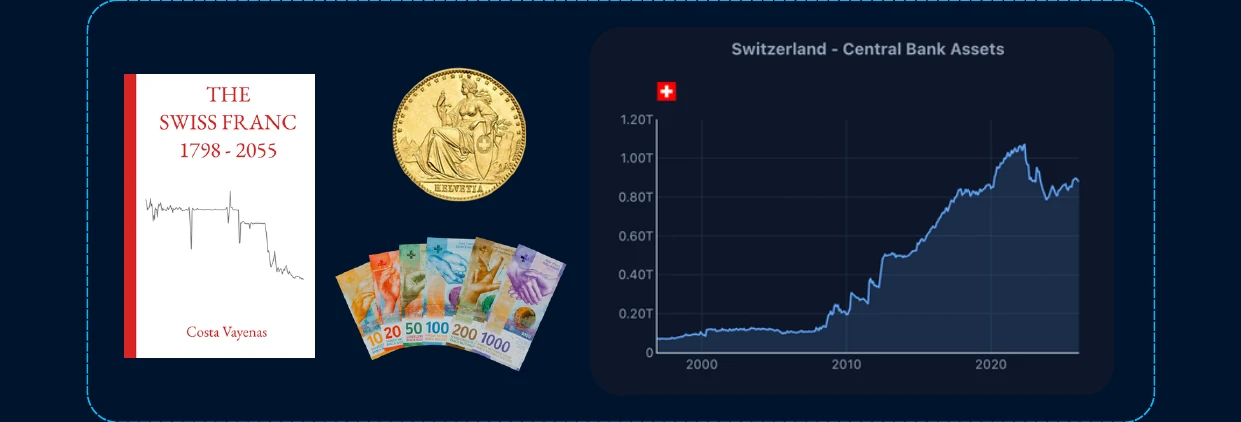
Costa Vayenas' The Swiss Franc, from 1798 to 2055 (September 2025) is, on its surface, a work of meticulous financial history. It reconstructs the value of the Swiss franc from its very origins against the U.S. dollar, sterling, the euro-area currencies, the Japanese yen, and the Chinese renminbi, deploying original charts and data across more than two centuries of monetary life.
It explains how Switzerland has managed an ever-appreciating currency without industrial collapse. It projects, with sober quantitative reasoning, where the franc may stand against the dollar by mid-century. It closes by asking what "jurisdiction" will mean for asset values as states and individuals migrate toward digital money.
I. 1798 and the Meaning of Monetary Fragmentation
Vayenas begins at the beginning: 1798, the Helvetic Republic, and the imposition of a unified franc across Swiss territory for the first time. Before that date, as the historical record confirms, more than seventy distinct entities issued their own coins across the cantons. Payments were conducted with billons, small coins that changed character from one cantonal border to the next and were not always accepted beyond them.
To the Austrian economist, this is not chaos. This is, in fact, a recognizable approximation of what Hayek described in Denationalization of Money (1976): a competitive, decentralized landscape of monetary instruments, where issuers are disciplined by rejection. Coins that depreciate get refused. Issuers who inflate lose custom. The system is not elegant, but it is subject to a market test.
Rothbard, in What Has Government Done to Our Money? (1963), traces the same historical pattern: monetary unification is almost always presented as rationalization and convenience, but its structural effect is the removal of competitive discipline from money issuance and the concentration of the monopoly of inflation in fewer, and ultimately one, set of hands. The Helvetic Republic's imposition of a unified franc was, in this reading, not merely an administrative reform. It was the first step in a two-century process of monetary centralization that would end, as it always ends, with a central bank, fiat currency, and the quiet erosion of purchasing power.
That Switzerland's journey through this process produced a franc that still stands as the world's strongest major currency speaks not to the virtue of centralization, but to the extraordinary institutional constraints that Switzerland placed around that central bank, constraints that were, significantly, themselves a product of the country's deeply decentralized, federalist, and direct-democratic political culture.
This is the first great irony that Vayenas documents and that Austrian theory explains: the Swiss franc survived the 20th century better than almost any other currency precisely because Swiss political institutions, the referendum, the cantonal structure, the fiscal discipline enforced by local accountability, recreated, at the political level, some of the disciplinary pressures that competitive monetary fragmentation once imposed at the market level.
II. The Gold Standard Era: Switzerland's Relative Virtue
From 1850 to 1936, Switzerland operated within the international gold standard framework, first through its membership in the Latin Monetary Union (1865) and then through independent management after the Union's effective collapse during World War I. Vayenas documents the franc's stability against gold-linked currencies across this period, and the charts he provides make the point visually obvious: when currencies are anchored to gold, their cross-rates are essentially flat. When the anchor is lifted, the divergences begin.
For Rothbard, the gold standard was not an arbitrary historical convention. In The Mystery of Banking (1983) and in his monumental A History of Money and Banking in the United States (2002), he argues that gold emerged through market processes as the most widely accepted, durable, scarce, and divisible medium of exchange. Its role as monetary anchor was not imposed by governments, it was recognized by them, after the fact. And its virtues were precisely those that governments found inconvenient: it limited credit expansion, it constrained deficit spending, it imposed a hard ceiling on the ability of banks to pyramid deposits above their reserves.
Switzerland's adherence to gold convertibility through the interwar period, longer and more tenaciously than most European states, was a direct consequence of the political culture Vayenas describes. Swiss voters did not want inflation. Swiss cantons resisted fiscal transfers. The Swiss National Bank, founded only in 1907 (late, even by European standards), was structurally cautious and institutionally conservative.
The critical moment came in 1936, when Switzerland was the last major country to abandon the gold peg, reluctantly devaluing the franc by 30% after France, Belgium, and the Netherlands had already done so. Even this devaluation was experienced domestically as something close to a betrayal of principle, a trauma, Vayenas' narrative suggests, that shaped Swiss monetary culture for generations.
From an Austrian perspective, 1936 was not the end of Swiss monetary virtue. It was the end of its structural guarantee. From that point forward, the franc's soundness would depend not on the discipline of gold convertibility, but on the discipline of institutions, which is always more fragile, always more susceptible to political pressure, always more dependent on the particular individuals in positions of authority.
That Switzerland managed this transition more successfully than almost any other country is remarkable. That it managed it imperfectly, as it inevitably would, is what the rest of the 20th century and the opening decades of the 21st make abundantly clear.
III. The SNB's Balance Sheet and the Contradiction at the Heart of Swiss Monetary Policy
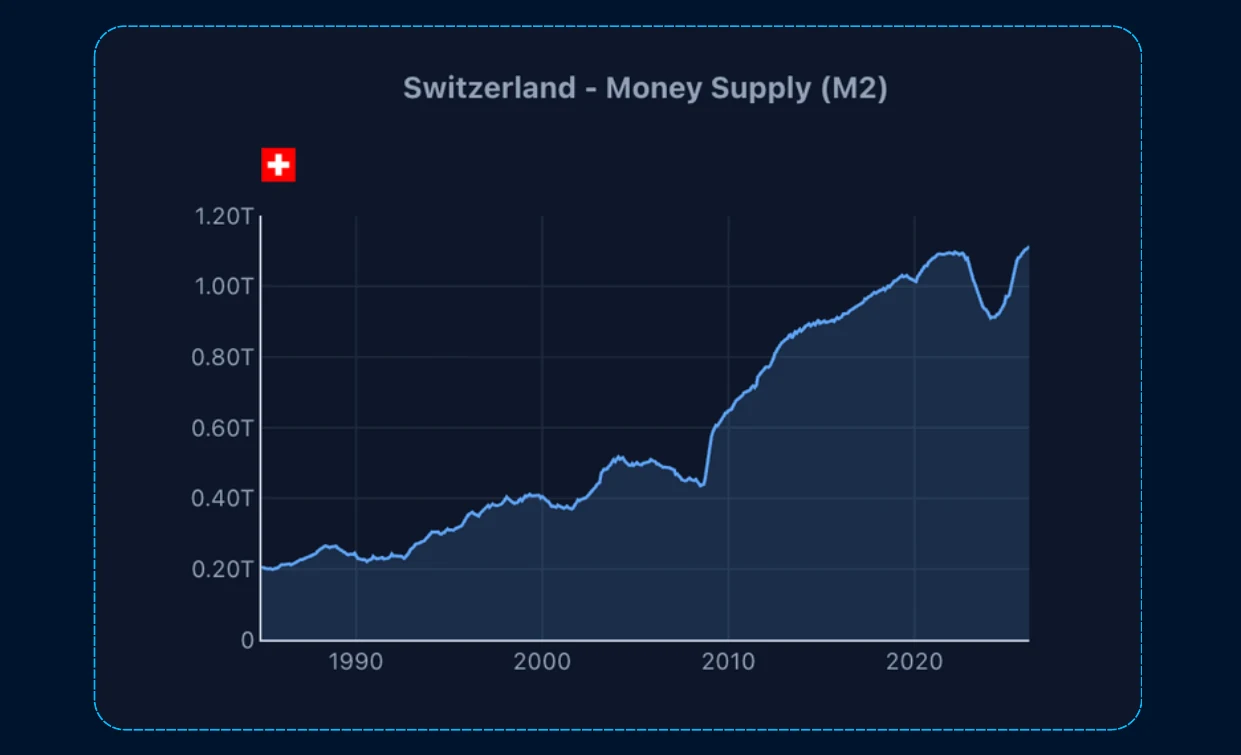
Vayenas is clear-eyed about one of the most extraordinary facts in contemporary monetary history: the Swiss National Bank, in its effort to suppress the appreciation of the franc, has accumulated a foreign exchange reserve portfolio that dwarfs Switzerland's entire GDP. As of recent years, the SNB holds assets exceeding CHF 700 billion against a Swiss GDP of roughly CHF 780 billion, a ratio unmatched by any comparable central bank in the developed world. To the layperson, this might look like strength: a rich country's central bank, flush with assets. To the Austrian economist, it is something altogether more alarming.
Rothbard's theory of money creation is unambiguous. Every expansion of the money supply beyond the real savings available represents a Cantillon transfer, a redistribution of purchasing power from later recipients of the new money to earlier ones. When the SNB buys foreign assets (euros, dollars, equities in foreign stock markets) by creating Swiss francs, it is not generating wealth. It is transferring it. It is diluting the real value of existing franc holdings and channeling the initial benefit to exporters and financial intermediaries who receive the newly created francs first.
This is the Cantillon effect named after Richard Cantillon's 18th-century insight: newly created money is not neutral. It flows through the economy like a dye through water, visible at first in certain hands, diffused only gradually and unevenly through prices. The SNB's interventions to weaken the franc have consistently enriched Swiss export industries (watches, pharmaceuticals, machinery) at the expense of Swiss households, whose imported purchasing power was quietly suppressed.
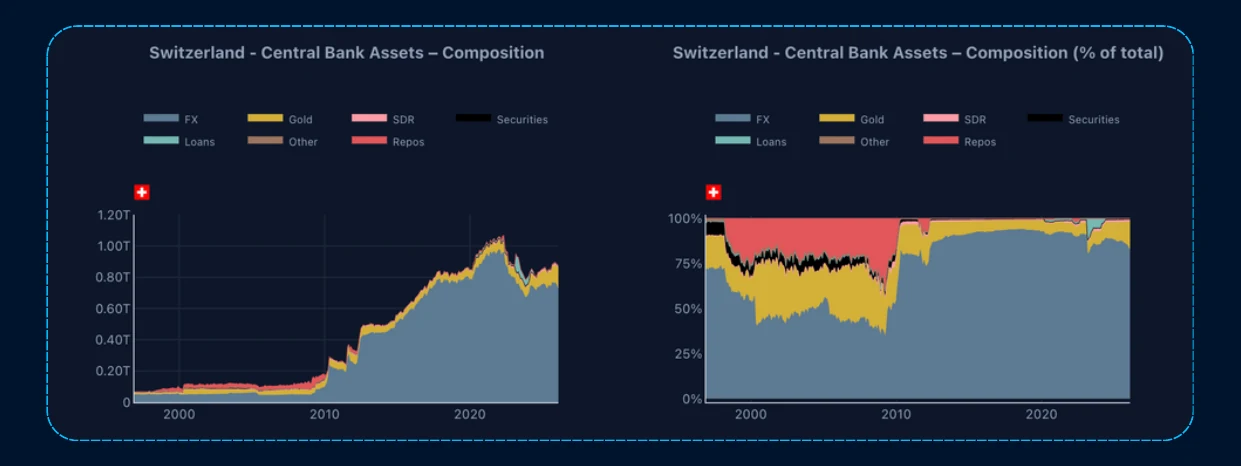
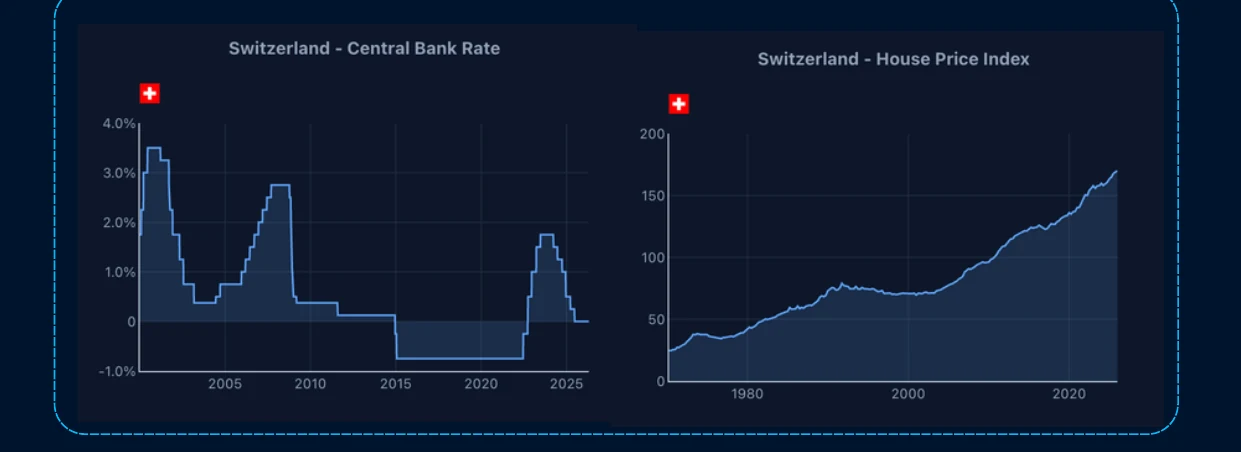
Furthermore, Mises' Business Cycle Theory, elaborated in Human Action (1949) and in The Theory of Money and Credit (1912), predicts that artificially suppressed interest rates will trigger malinvestment: capital allocation toward projects that appear profitable at the artificially low cost of credit but which cannot sustain themselves when rates normalize. The SNB's policy of negative interest rates between 2015 and 2022, the longest experiment with sub-zero official rates in monetary history, was precisely such a suppression. Swiss real estate prices rose to levels that bear no relationship to the underlying productive economy. The Swiss pension system was forced to seek yield in increasingly risky assets. Zombie firms survived on cheap credit that genuine market discipline would have eliminated.
IV. The 2011–2015 Peg: A Hayekian Tragedy in Three Acts
On September 6, 2011, the SNB announced a minimum exchange rate of CHF 1.20 per euro, pledging to defend it with unlimited foreign currency purchases. On January 15, 2015, it abandoned the peg without warning, sending the franc surging 15–20% against the euro within minutes. The event, the "Frankenshock", remains the largest single-day move of a major currency in post-war history.
Hayek's Prices and Production (1931) provides the analytical template for understanding why the peg was always doomed, and why its abandonment was so violent. When a central bank artificially holds down the value of its currency, it is, in effect, lying to the price system. The exchange rate is a signal, it conveys information about relative productivity, capital flows, and the relative preferences of savers and investors across jurisdictions. A pegged rate is a suppressed signal. Entrepreneurs, financial institutions, and households make decisions based on the false price, building positions that are implicitly leveraged against the assumption that the central bank can maintain the lie indefinitely.
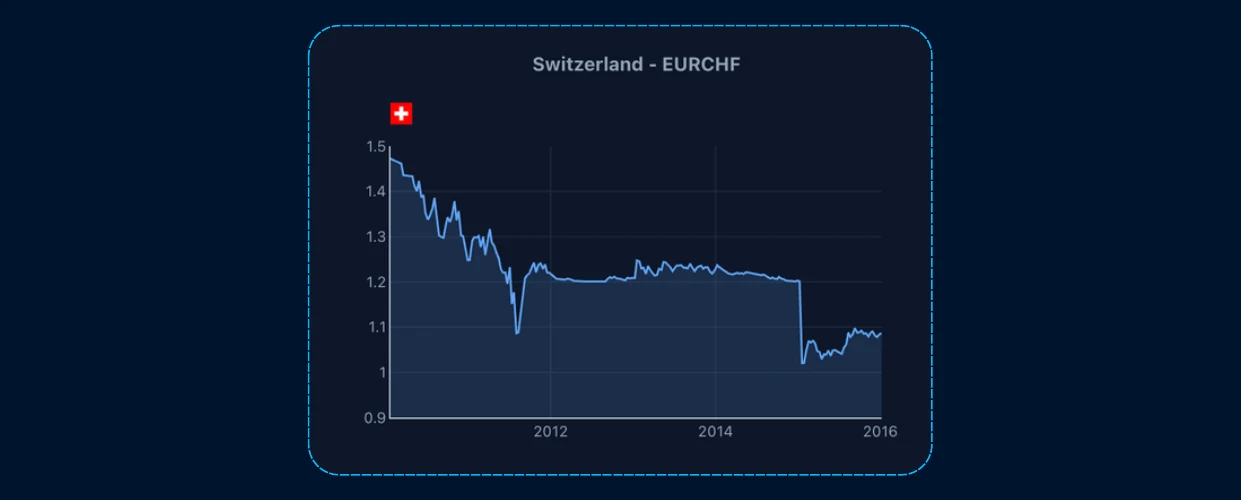
When the SNB finally acknowledged what the markets had long suspected, that maintaining the peg would require the balance sheet to grow to levels incompatible with any plausible mandate, the repricing was instantaneous and brutal. The accumulated distortions of three years of artificial suppression corrected in a matter of hours. Swiss exporters, who had built supply chains and pricing structures around CHF 1.20, faced overnight margin compression of 15-20%. Forex brokers who had sold the franc short went bankrupt. The SNB itself posted a loss of roughly CHF 50 billion in the first quarter of 2015.
This is precisely what Hayek called the "crack-up" dynamics of sustained artificial price suppression: the longer the distortion is maintained, the more capital misallocated around it, and the more violent the eventual correction. There is no free lunch in exchange rate management. The SNB's peg did not prevent adjustment, it concentrated it, delayed it, and thereby amplified it.
Rothbard would add a harder verdict: the peg was not a policy error. It was a structural feature of central banking. Central banks are not firms subject to market discipline. Their losses are socialized. The SNB's CHF 50 billion loss in Q1 2015 was not paid by the SNB's governors. It was paid by Swiss taxpayers, through reduced profit distributions to the Confederation and the cantons. The incentive structure of a central bank systematically encourages exactly the kind of short-term political expediency that produced the 2011 peg in the first place.
V. Why the Franc Keeps Appreciating: The Austrian Answer
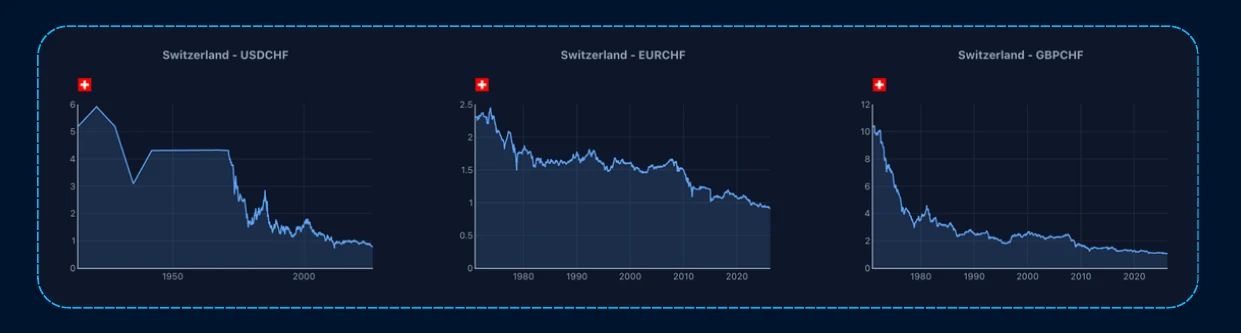
The deepest question Vayenas poses, and the one that most resists conventional explanation, is why the franc has appreciated, persistently and structurally, for over two centuries. Against the dollar, against sterling, against every major currency of Switzerland's European neighbors, the franc has moved in one direction: up. Not smoothly, not without interruption, but inexorably.
The standard explanations, Swiss productivity, current account surpluses, safe-haven demand in crises, are all true but insufficient. They describe symptoms without identifying causes. The Austrian answer begins with Mises' insight about the relationship between money and the institutional environment in which it circulates. Money is not just a technical medium of exchange. It is a claim on the social order. Its value reflects the collective judgment of savers and investors about the reliability of the institutions, political, legal, monetary, that govern its issuance and its purchasing power.
Switzerland's institutions have been, by the standards of the 20th century, exceptionally reliable. Direct democracy constrained profligate spending. Federalism prevented fiscal centralization. The militia army and strict neutrality minimized the state's war-making ambitions, the single most destructive force in monetary history. Rothbard, in his analysis of how wars have historically driven monetary debasement (A History of Money and Banking), is unequivocal: it is war finance, above all, that destroys currencies. Switzerland has not fought a war since 1815.
The franc appreciates, in the final analysis, because Swiss institutions produce a lower rate of monetary debasement over time than any comparable jurisdiction. This is not a coincidence. It is not luck. It is the direct consequence of specific institutional choices, decentralization, direct democracy, fiscal conservatism, neutrality, that happen to align, structurally, with the conditions that Austrian economists have always identified as prerequisites for sound money.
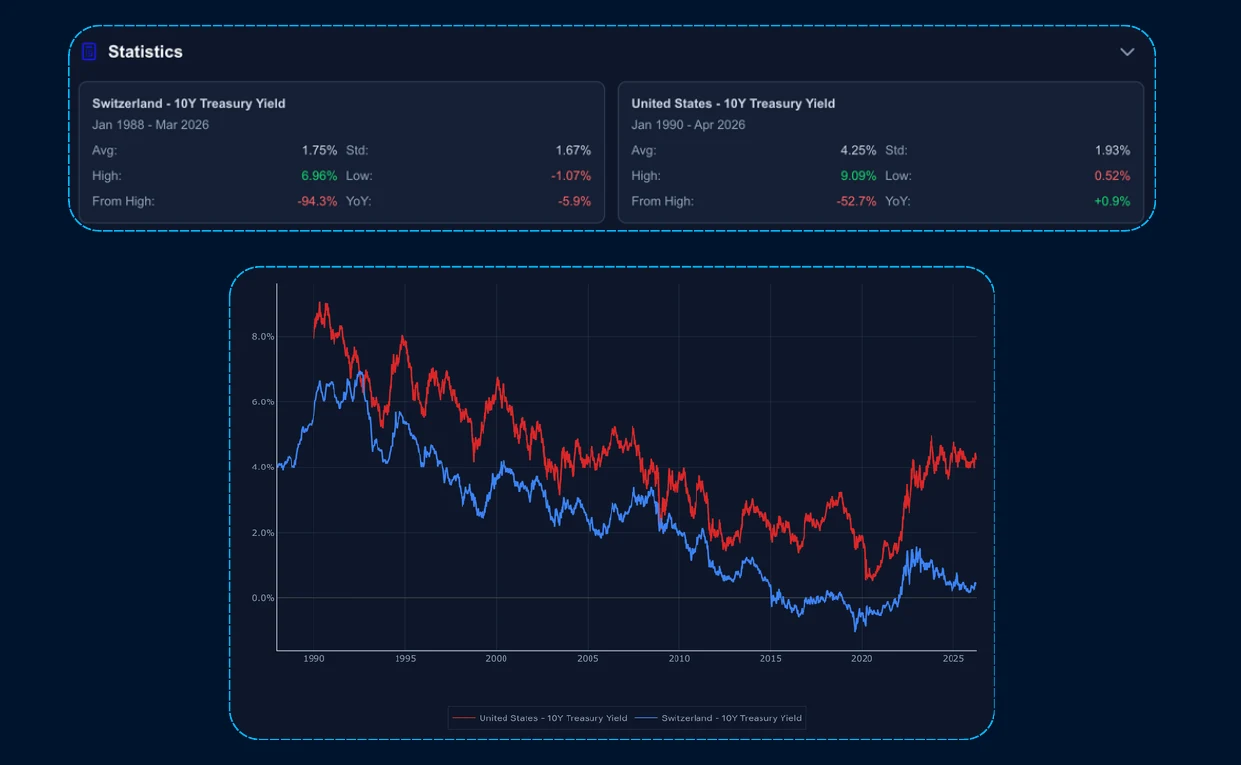
Vayenas' long-term bond yield differentials which he uses to project the franc-dollar rate toward 2055 are, in Austrian terms, a proxy for the market's expectation of relative debasement rates. When Swiss yields are persistently below U.S. yields, it means bond markets expect the SNB to print less, and Swiss fiscal authorities to borrow less, than their American counterparts. The yield differential is not a cause of franc appreciation. It is, like the franc appreciation itself, an effect of the underlying institutional divergence.
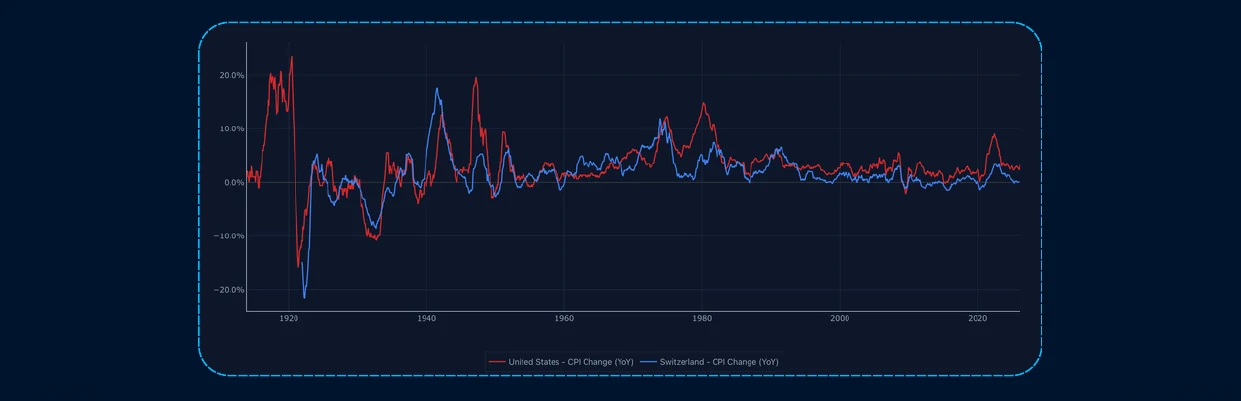
The previous chart displays the consumer prices year-on-year change for the last 100 years for both Switzerland and the United States of America. Since the USA defaulted on their debt in 1971 by suppressing the convertibility of the dollar notes into Gold (Bretton Woods), the swiss people experienced a lower increase in prices almost every year. The strong swiss currency being very helpful in that result.
The above has a logical impact on the government bond yield of each country, leading to lower interest rates in Switzerland. We even witnessed negative rates !!!
VI. Digital Money, Jurisdictional Competition, and the Road to 2055
Vayenas concludes his book by asking what the rise of digital money, CBDCs, stablecoins, privately issued digital currencies, means for a world in which the link between a currency and a sovereign territory is becoming increasingly optional. It is here that the book's forward-looking analysis converges most strikingly with the most radical strand of Austrian monetary thought.
Hayek's Denationalization of Money, published in 1976 and still among the most provocative texts in monetary economics, argued that the root cause of monetary instability was the government monopoly on currency issuance. His solution was not to reform central banking but to abolish the monopoly: to allow private issuers to compete, letting the market select for currencies that maintained their value and eliminating those that inflated.
Hayek's vision never materialized in the form he imagined. But the landscape Vayenas describes, states and private individuals shifting toward new forms of digital money, with "jurisdiction" becoming a key variable in asset value is, in important respects, the Hayekian competitive monetary order arriving through the back door of technology rather than through the front door of legal reform.
For the Swiss franc, this creates an unusual dynamic. For most of the 20th century, the franc was the closest thing to sound money available to a global investor. It was the exit from dollar debasement, from euro inflation, from yen money-printing. To some degree, it still is. But in a world where digital alternatives exist, the franc competes on institutional grounds: Swiss privacy law, Swiss property rights, Swiss political stability, Swiss rule of law.
Vayenas sees this clearly. From an Austrian perspective, what it means is that the Swiss franc's long-term appreciation is no longer automatic. It will persist only as long as Switzerland's institutional framework remains genuinely superior to its digital and geopolitical competitors. The moment Swiss authorities move to control capital flows, to implement a CBDC that surveils transactions, to subordinate monetary policy to EU coordination, the competitive advantage that has driven 227 years of franc appreciation will erode.
Get the next article by email
One email when a new piece is published. Nothing else, and one-click unsubscribe from any message.