

#7 - The Price of Time
The interest rate is the price of time — the cost of capital, the discount rate on every future cash flow, and the signal coordinating every intertemporal decision in the economy. Rooted in human time preference, it is the one price that underlies every other. When set by markets it encodes truth; when set by committee it encodes fiction, with consequences that compound silently until they cannot be ignored.
by Game Of Francs Research Team
The interest rate is the price of time. It is simultaneously the cost of capital for every business that invests, the discount rate applied to every future cash flow ever calculated, and the signal that coordinates every intertemporal decision in the economy. When it is set by markets, it encodes truth. When it is set by committee, it encodes fiction — with consequences that compound silently until they cannot be ignored.
I. The Most Consequential Price in the Economy
Every market economy produces millions of prices every day. The price of wheat, of labour, of copper, of a square metre of office space in Zurich. Each conveys information — about scarcity, about demand, about the relative urgency of competing uses for limited resources. Together, they constitute what Hayek called the price system: a decentralised, continuously updated information network of extraordinary complexity, capable of coordinating the decisions of billions of individuals without any central directing authority.
Among all these prices, one stands apart. Not because it is the largest, or the most visible, but because it is the price that underlies every other price in the system — the price from which every investment decision, every savings decision, every valuation, every business plan, and every government budget ultimately derives its logic.
That price is the interest rate.
The interest rate is the price of time. More precisely, it is the price of present goods expressed in terms of future goods — the premium that borrowers pay to obtain resources today rather than waiting, and the reward that savers receive for deferring consumption into the future. It is simultaneously the cost of capital for every business that borrows to invest, the discount rate applied to every future cash flow in every financial model ever constructed, the benchmark against which every asset class is valued, and the signal that coordinates the intertemporal decisions of every participant in the economy.
When the interest rate is set by markets — by the genuine interaction of savers who supply capital and borrowers who demand it — it encodes extraordinarily valuable information about the real preferences of real people regarding time. When it is set by a committee of central bank economists, that information is suppressed. A price that no longer reflects the genuine preferences of market participants cannot coordinate those participants' decisions accurately. The distortions that follow are not accidents. They are the predictable and systematic consequence of replacing the most important price in the economy with an administrative decision.
II. What an Interest Rate Actually Is: The Forgotten Theory
The modern central banking discussion of interest rates is almost entirely procedural. Rates are set at committee meetings, calibrated to inflation and unemployment readings, communicated through forward guidance, and adjusted in increments of twenty-five basis points. What this framework almost entirely omits is the question that the classical and Austrian economists placed at the centre of their analysis: what is an interest rate, at its most fundamental level, and where does it come from?
The answer begins not with central banks or financial markets but with human nature itself. Every human being, in every culture and every historical period, prefers present goods to future goods of the same kind and the same quantity. This is not irrationality. It is a rational acknowledgment that the future is uncertain, that present wants are pressing, and that time itself has a cost.
Eugen von Böhm-Bawerk, the Austrian economist who in the 1880s produced what remains the most rigorous analysis of capital and interest in the history of economics, called this phenomenon time preference. The interest rate, in his framework, is the market expression of time preference — the rate at which individuals are willing to exchange present goods for future goods, revealed through their actual behaviour as borrowers and savers.
Ludwig von Mises extended this analysis in The Theory of Money and Credit (1912) and Human Action (1949), developing the concept of the originary interest rate — the pure time preference component of interest that exists independently of any monetary system. For Mises, the interest rate is not primarily a monetary phenomenon. It is a reflection of the universal human preference for the present over the future, expressed in the structure of prices throughout the economy.
This theoretical foundation has a crucial practical implication. The natural interest rate reflects the genuine time preferences of the actual people participating in the economy. A central bank that sets the interest rate below the natural rate is not choosing a better rate than the market would choose. It is suppressing the information that the natural rate conveys and replacing it with an administrative fiction. The consequences propagate through every part of the economy that makes decisions based on the price of time.
III. The Transmission Mechanism: How Rates Touch Everything
The interest rate's influence operates simultaneously across every major sector of economic life through transmission channels of varying speed, visibility, and severity.
The investment channel is the most direct. Every business investment involves a comparison between the expected return and its cost of financing. When rates are low, projects that would be unprofitable at higher rates become viable. The hurdle rate falls, capital is deployed faster, and the economy's capital stock grows faster than it would if the cost of capital reflected genuine savings availability.
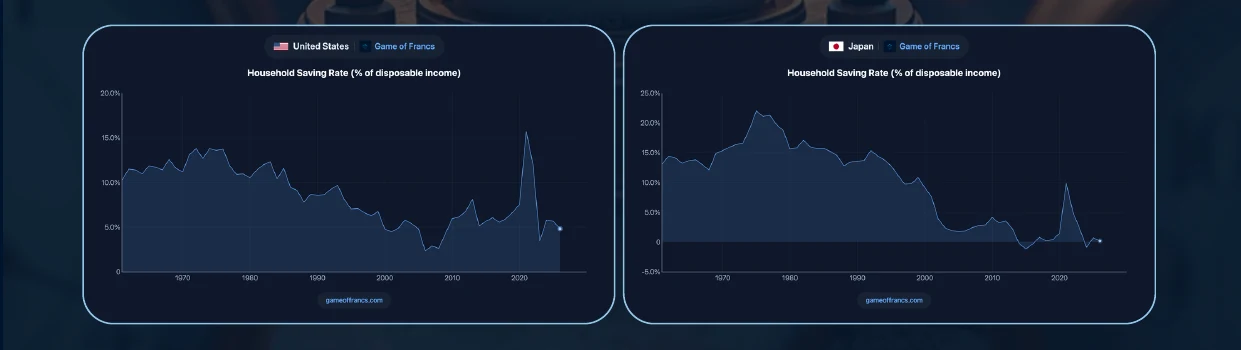
The savings channel operates in the opposite direction. When the risk-free rate is suppressed to zero or below, the incentive to save diminishes and savers are forced into riskier assets to earn any return at all. This forced migration up the risk curve creates fragility throughout the financial system.
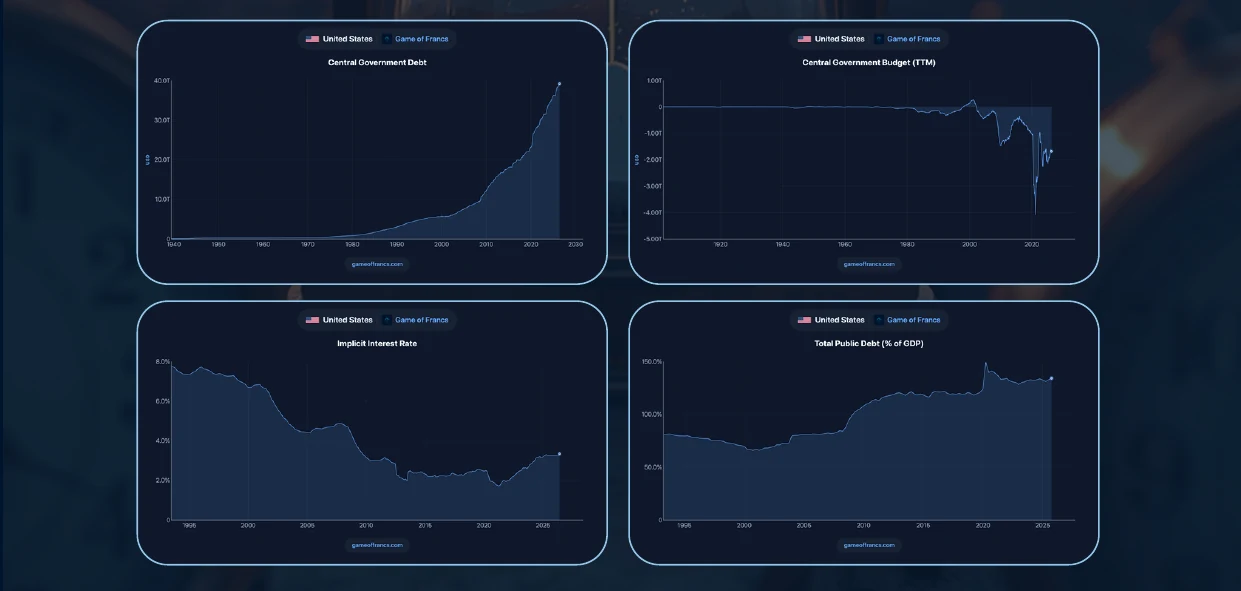
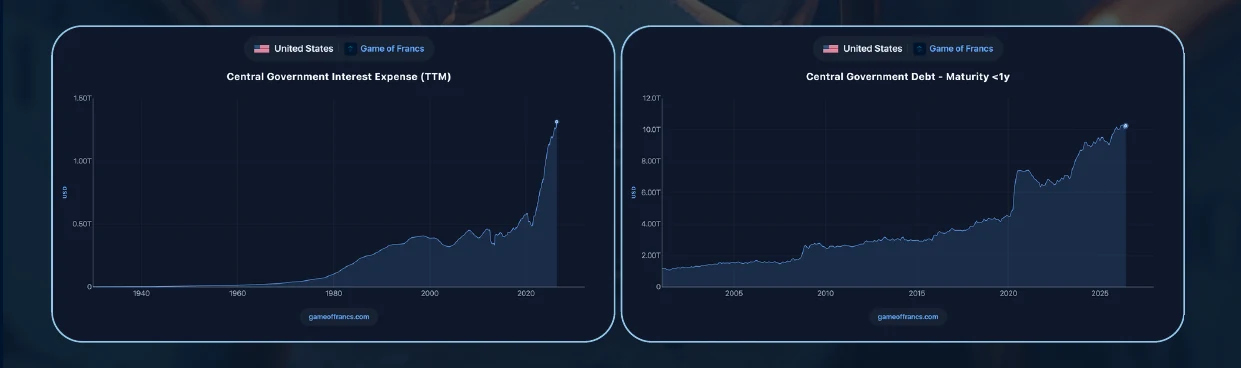
The government debt channel is the most politically sensitive. Every percentage point increase in rates raises the cost of servicing outstanding government debt. A government with $35 trillion of debt faces an annual interest bill of $350 billion for every 1% of average interest rate. This creates a structural pressure on central banks entirely separate from their formal mandates: the permanent temptation to keep rates low to keep government finances manageable, at the expense of savers and sound money.
The pension channel is the silent victim. Defined-benefit pension schemes calculate the present value of future liabilities using discount rates. When discount rates fall, funding gaps widen. Fifteen years of near-zero rates produced the largest pension funding crisis in the history of the developed world.
IV. The Asset Price Inflation Machine: Real Estate, Bonds, and Equities
Among all the transmission channels of interest rate policy, the most powerful and least honestly discussed is the one that directly inflates the price of the three great stores of wealth in the modern economy: real estate, bonds, and equities.
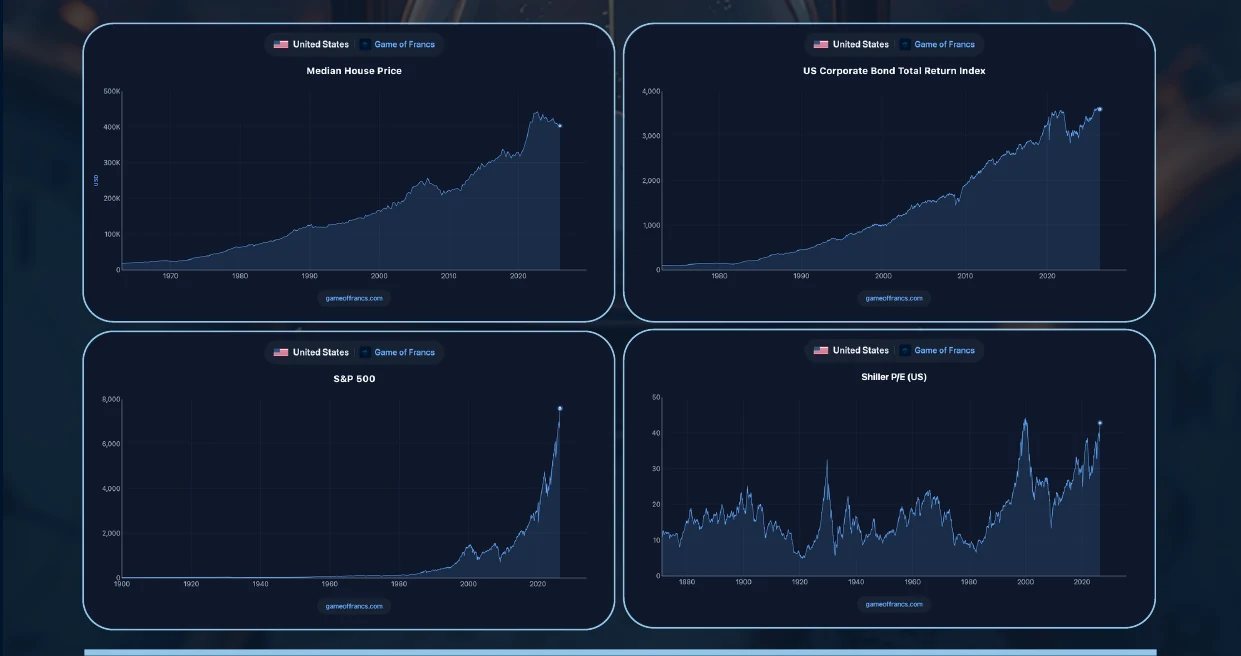
Real estate: the loan-based amplification. The vast majority of real estate transactions are financed by borrowing. When a thirty-year mortgage rate falls from 6% to 3%, the monthly payment on a given loan amount roughly halves. The same household income that could service CHF 500,000 at 6% can now service CHF 1,000,000 at 3%. Purchasing power has doubled — not because income has grown, but because the cost of borrowing has fallen. Multiply this across millions of households simultaneously and the result is a surge in demand absorbed entirely by rising prices.
Bonds: the mathematical certainty. A bond's price is determined by discounting future cash flows at the prevailing market rate. When the rate falls, those same future cash flows are worth more in present terms, and the price rises. A bond with ten years duration rises approximately 10% for every 1% decline in rates. A thirty-year bond has duration of roughly twenty years: a 1% rate cut produces a 20% price gain. This is not a tendency. It is an arithmetic identity.
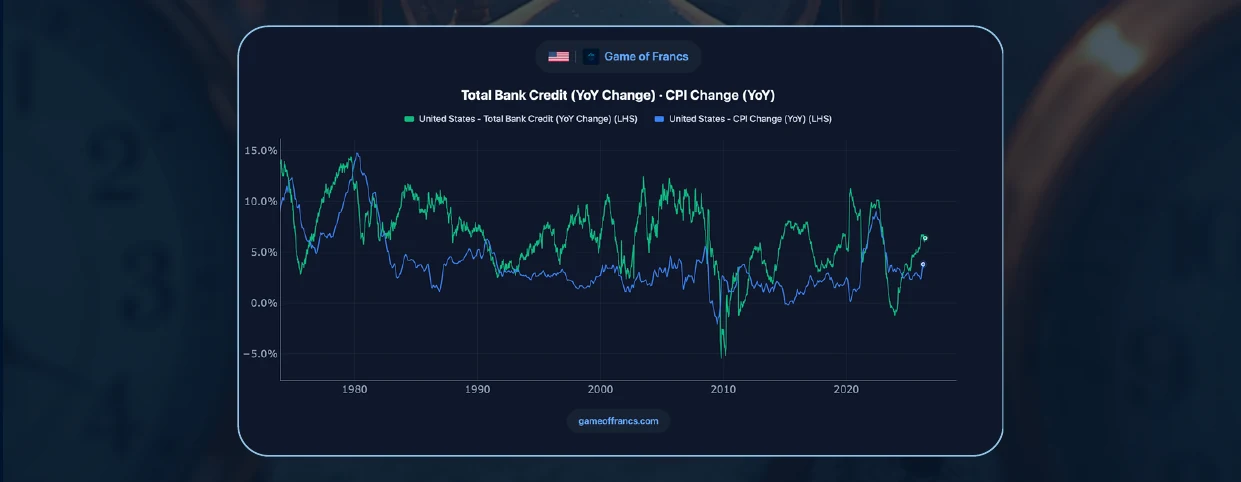
Equities: the double amplification. Rate cuts inflate equity prices through two compounding channels simultaneously. First, the discount rate channel: lower rates make every future earnings stream more valuable in present terms, inflating valuations without any improvement in the underlying business. Second, the credit expansion effect: lower rates expand total credit in the economy, which circulates as genuine revenue for businesses. Higher revenues discounted at a lower rate produce valuations that are doubly inflated. When rates rise, both channels reverse simultaneously.
V. The Inequality Machine: Who Owns the Assets
The three mechanisms described above have a common structural feature that is the key to understanding why inequality in the developed world has reached levels not seen since the Gilded Age.
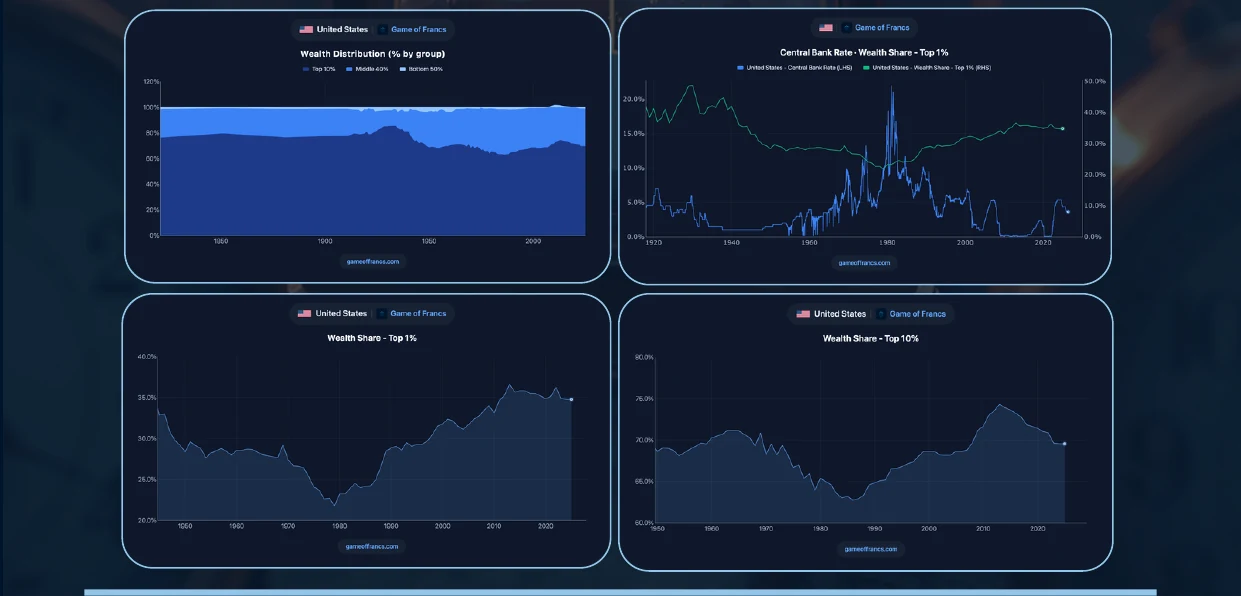
All three of these assets are owned overwhelmingly by the wealthy. By definition, the primary distinction between a wealthy household and a non-wealthy household is asset ownership. A wealthy household holds most of that wealth in equities, bonds, and real estate. A non-wealthy household holds most of its resources in labour income and liquid savings — which benefit not at all from asset price inflation.
In the United States, the top 1% own approximately 31% of all financial assets and roughly 40% of all privately held real estate. The top 10% own roughly 89% of all equities and 85% of all bonds. The bottom 50% own less than 3% of financial assets.
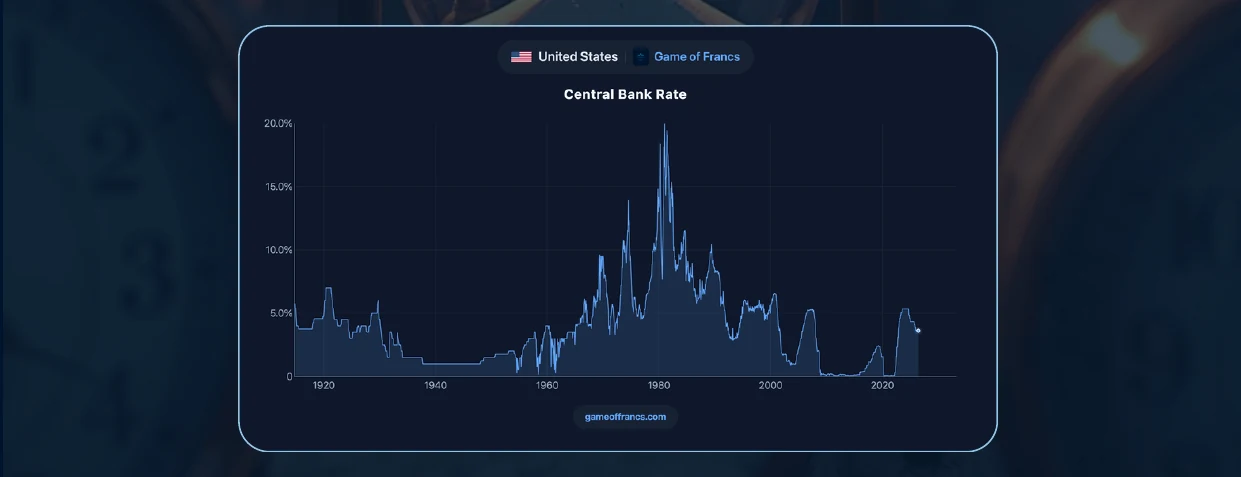
When the Federal Reserve cut rates from 5.25% to 0.25% in 2008 and maintained them near zero for seven years, it produced a decade-long inflation of equities, bonds, and real estate. The S&P 500 rose 600%. US residential real estate rose approximately 50% in real terms. Total American household financial wealth grew by roughly $50 trillion. The top decile captured the overwhelming majority of that gain — because they owned the overwhelming majority of the assets whose prices were inflated.
This is the structural mechanism behind the inequality surge that has dominated political discourse across the developed world for fifteen years. It is not primarily the product of tax policy, globalisation, or corporate greed. It is primarily the product of monetary policy — the systematic inflation of asset prices through interest rate suppression, in a world where asset ownership is itself the definition of wealth.
VI. The Austrian Business Cycle: What Happens When the Price of Time Is Faked
The Austrian theory of the business cycle — developed by Ludwig von Mises and elaborated by Friedrich von Hayek in Prices and Production (1931) — provides the most rigorous analytical account of what happens when the interest rate is set below its natural market level.
The mechanism begins with a divergence between the rate at which capital is available and the rate at which savers are genuinely willing to supply it. Credit expands, not because more real savings have become available, but because the banking system creates new purchasing power not backed by any prior act of consumption deferral.
This expansion of artificially cheap credit distorts the structure of production in a specific and predictable way. Businesses, observing financing costs that imply abundant savings and patient capital, initiate investment projects that would not be profitable at the natural rate — longer-horizon projects, more capital-intensive processes, ventures further removed from immediate consumer demand. The economy behaves as if there are abundant long-run savings available, when in reality the capital goods required must be bid away from alternative uses.
The result is what Mises called the boom: a period of apparently robust growth, full employment, rising asset prices, and expanding corporate investment, all built on the foundation of a credit expansion that cannot be sustained without continuous further expansion. Then comes the crisis. When the central bank is forced to raise rates — because inflation has appeared or financial fragility has become undeniable — the entire structure of malinvestment built on the false interest rate signal is exposed.
The policy error, in the Austrian framework, is not the recession. The recession is the cure, not the disease. The error was the artificial credit expansion that created the malinvestment — and the compounding error is the attempt to prevent the liquidation through further rate suppression, which merely extends the boom, deepens the eventual adjustment, and defers the pain at the cost of accumulating ever-larger distortions.
VII. Exhibit A: Fifteen Years of the Great Distortion
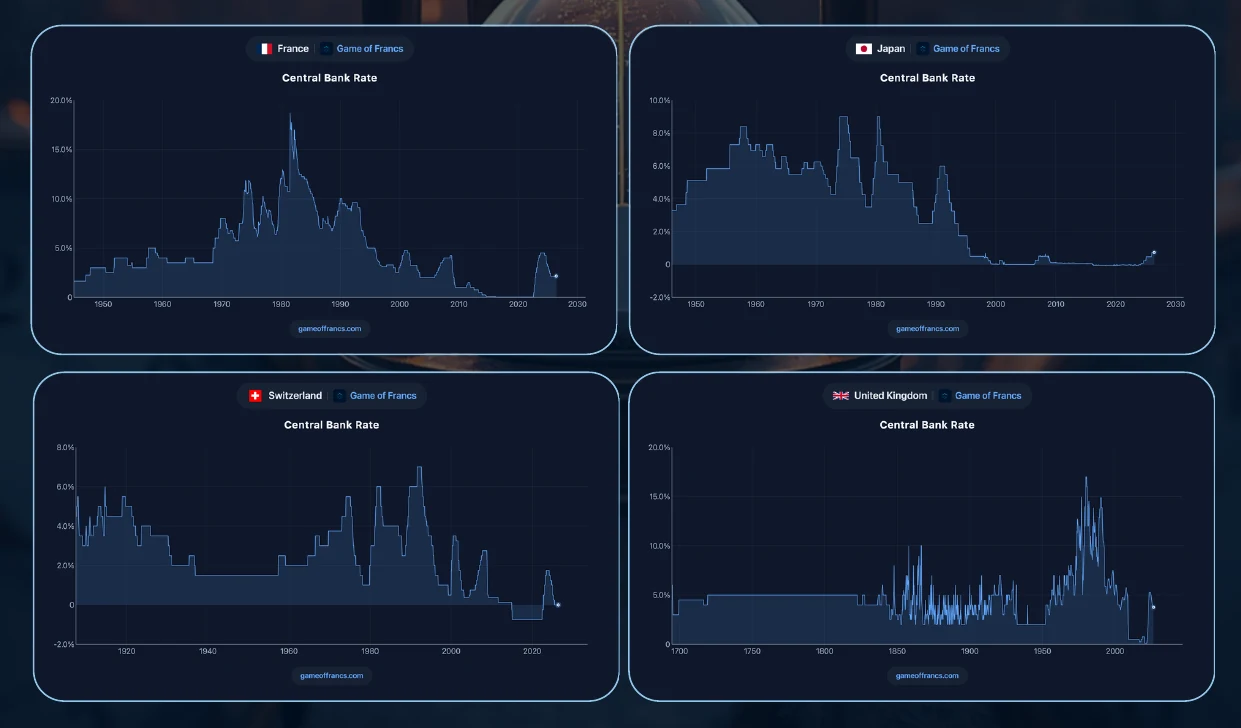
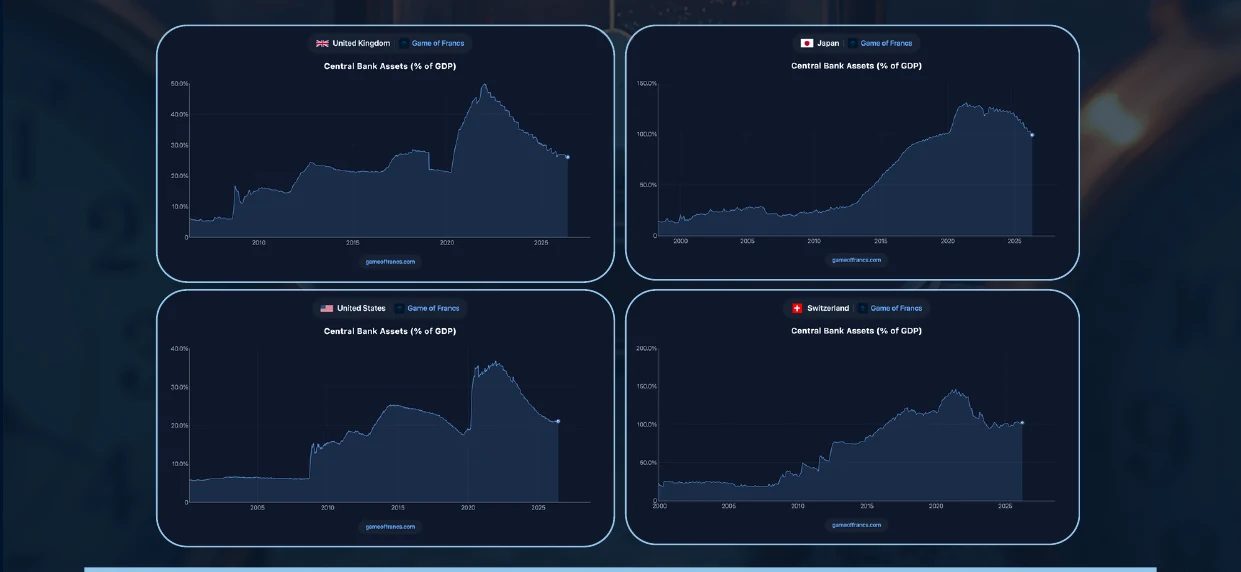
The period from 2008 to 2022 represents the most sustained and globally coordinated experiment in interest rate suppression in monetary history. The Federal Reserve held rates at zero or near-zero for seven years between 2008 and 2015. The ECB implemented negative deposit rates from 2014 and maintained below-zero rates until July 2022 — eight consecutive years. The Bank of Japan has maintained near-zero or negative rates since 1999.
Zombie companies — businesses that could not cover their interest expense from operating income at any normal rate level — proliferated across Europe and Japan, sustained by financing costs that bore no relationship to their economic productivity. The IMF estimated that zombie firms accounted for 10–15% of all listed companies in major developed economies by 2019.
Personal saving rates fell across the developed world as returns on safe assets disappeared. Pension funds unable to meet actuarial return assumptions on zero-yielding bonds migrated systematically into private equity, real estate, and high-yield credit — asset classes whose higher returns reflected genuine risk that their mandates were not designed to accommodate.
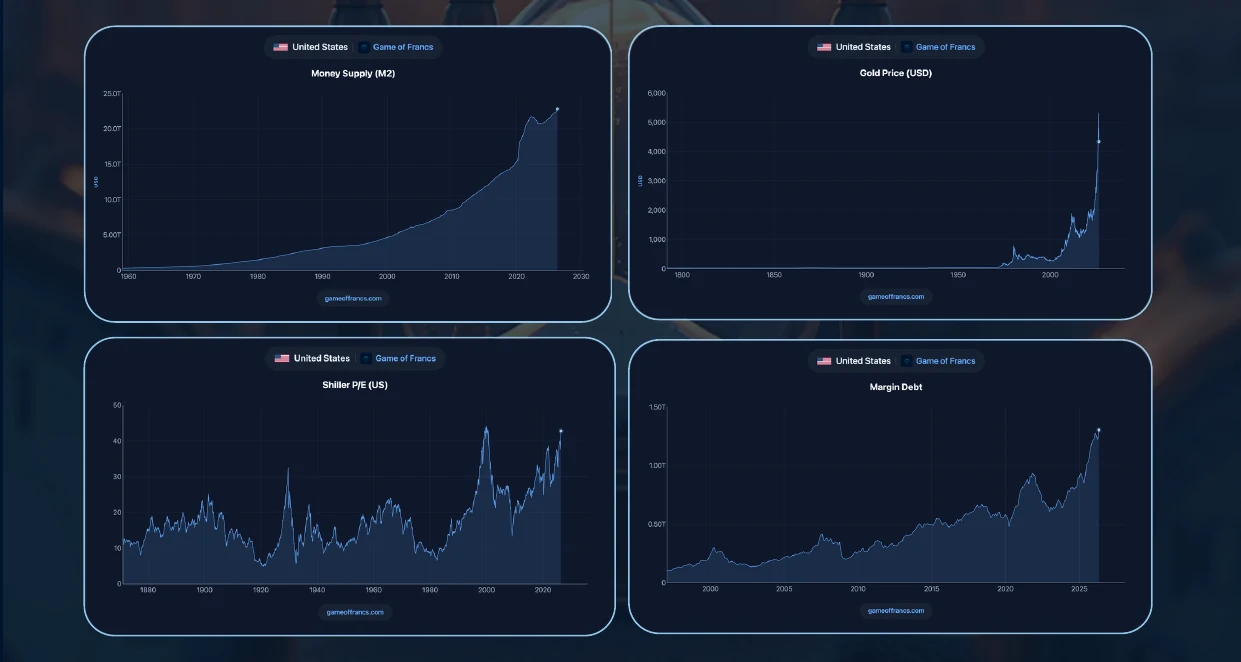
The S&P 500 rose from approximately 666 in March 2009 to 4,797 at its January 2022 peak — a gain of more than 600% in thirteen years. The Shiller CAPE ratio reached 38 by early 2022, a level exceeded in 150 years only at the peak of the dot-com bubble. These valuations were not primarily the product of extraordinary earnings growth. They were the product of discount rate suppression compounded by credit-driven revenue expansion — the double amplification operating at maximum force for the longest sustained period in history.
US federal debt grew from approximately $10 trillion in 2008 to over $35 trillion by 2024, financed largely at rates that bore no relationship to the fiscal risk embedded in those obligations. The suppressed interest rate allowed fiscal excess that genuine market financing would have constrained — and the bill was deferred into the future.
VIII. The Bill Arrives: 2021–2023 and the Rate Normalisation Shock
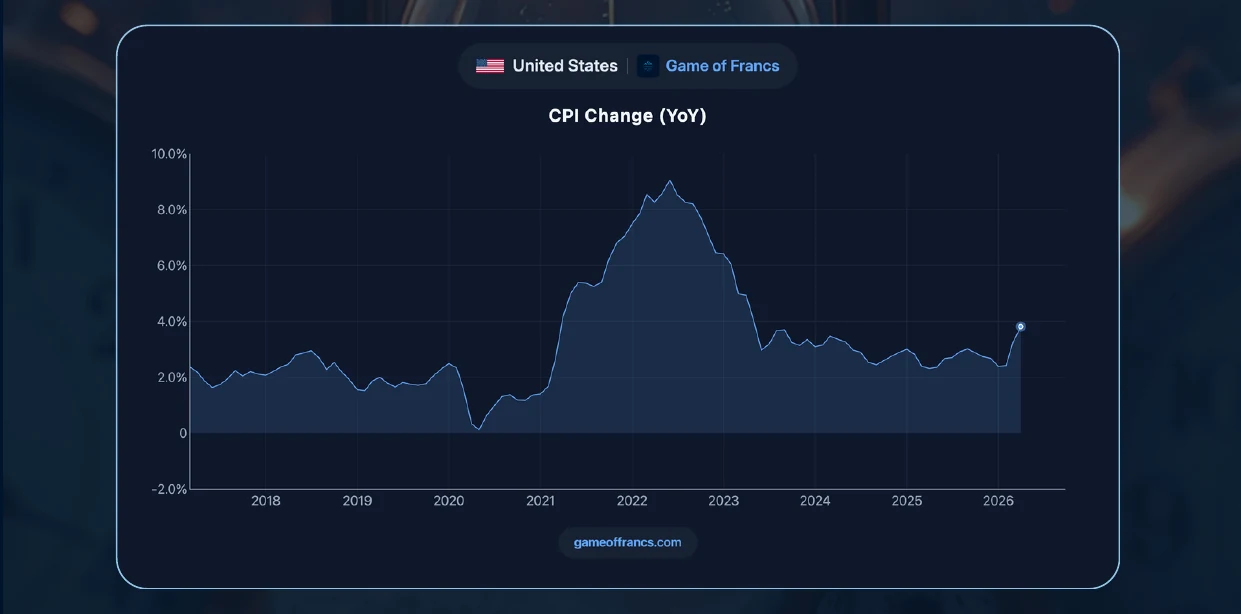
The inflation of 2021–2023 was not, as the Federal Reserve initially characterised it, primarily a supply-side phenomenon that would prove transitory. It was the delayed arrival of the monetary bill run up over fifteen years of extraordinary credit expansion — triggered by the COVID fiscal response but rooted in the accumulated distortions of a decade and a half of rate suppression.
The COVID response added the final layer: governments transferred trillions of dollars directly to households and businesses, financed by central bank money creation on an unprecedented scale. For the first time since the 1970s, newly created money reached wage earners and consumers rather than being confined to financial asset markets. The result was consumer price inflation not seen in the developed world since the stagflation era.
The Federal Reserve's response — raising rates from 0.25% to 5.5% in less than eighteen months — was the fastest hiking cycle in forty years. The assets and businesses built on the assumption of permanent zero rates faced a sudden and severe recalibration. Silicon Valley Bank collapsed in March 2023 when its long-duration bond portfolio — purchased at near-zero yields — declined catastrophically in value as rates rose. Commercial real estate faced a repricing of historic severity. Venture capital portfolios, valued at multiples of revenue that only made sense at zero discount rates, entered a sustained period of write-downs.
Each of these dislocations was a direct and mechanically predictable consequence of the Austrian analysis. The boom created the malinvestment. The rate suppression sustained it. The rate normalisation revealed it. The sequence was not random. It was the operating logic of the capital cycle, animated by fifteen years of artificially suppressed interest rates.
IX. The Sectors Most Durably Transformed
Not all the consequences of the great rate suppression are reversible simply because rates have normalised. Fifteen years of zero interest rates have produced structural changes that will persist regardless of where the policy rate now sits.
The real estate sector has been permanently transformed by the expectation of low rates embedded in prices, planning decisions, and urban development patterns. The adjustment to a world of 4–5% mortgage rates is not a brief disruption. It is a multi-year repricing of the entire built environment — with the heaviest burden falling on those who purchased at the peak of the rate suppression cycle.
The corporate sector has been structurally altered by a decade of shareholder distributions financed by cheap debt. S&P 500 companies spent more on share buybacks and dividends between 2010 and 2020 than they earned in operating income in several individual years. The capital not invested in productive capacity during that period represents a permanent deficit in productive potential.
The pension sector faces a generational reckoning. The promises made to workers who planned retirements around guaranteed incomes were made against investment return assumptions that zero rates made mathematically impossible to meet on safe assets. The fundamental mismatch remains one of the largest unacknowledged fiscal liabilities in the developed world.
The government sector faces a debt service burden that constrains every other policy choice. The United States now spends more on interest on its national debt than on its entire defence budget. The political economy consequences — the pressure on central banks to suppress rates to make debt manageable, the temptation to inflate away obligations, the crowding out of productive public investment by debt service — will shape the next generation of fiscal and monetary policy as directly as the original rate suppression shaped the last.
X. Conclusion: The Price That Governs All Prices
The interest rate is not a technical monetary instrument with narrow financial implications. It is the price that governs all prices — the signal coordinating every investment, every savings decision, every asset valuation, and every government budget in the economy.
Fifteen years of suppressing that price below its natural level inflated three asset classes simultaneously: real estate through loan-based purchasing power, bonds through mathematical certainty, and equities through the double amplification of discount rate compression and credit expansion. The ownership of those three asset classes is concentrated overwhelmingly in the wealthiest segment of the population — not by accident, but by definition. Rate suppression therefore transferred wealth, at historic scale and with mechanical precision, from non-owners to owners.
The inequality debate that has dominated Western political discourse is, at its root, a monetary policy debate. The anger is real. The mechanism is real. What is almost universally missing is the honest identification of the cause.
The price of time cannot be set honestly by committee. Every departure from its genuine market discovery transfers wealth upward, allocates capital badly, and defers a reckoning that eventually arrives.
Get the next article by email
One email when a new piece is published. Nothing else, and one-click unsubscribe from any message.