

#6 - The Capital Cycle
Edward Chancellor's capital cycle framework — high returns attract capital, capital floods the industry, supply expands, returns compress — applied to the 2025–2026 AI infrastructure buildout, where venture and hyperscaler capex have reached a magnitude that historically precedes deeply disappointing returns.
by Game Of Francs Research Team
There is a mechanism in market economies so reliable, so well-documented, and so consistently ignored by the investors it periodically destroys, that its rediscovery in each new cycle must count as one of the more remarkable recurring phenomena in financial history.
That mechanism is the capital cycle. And right now, it is operating at full force.
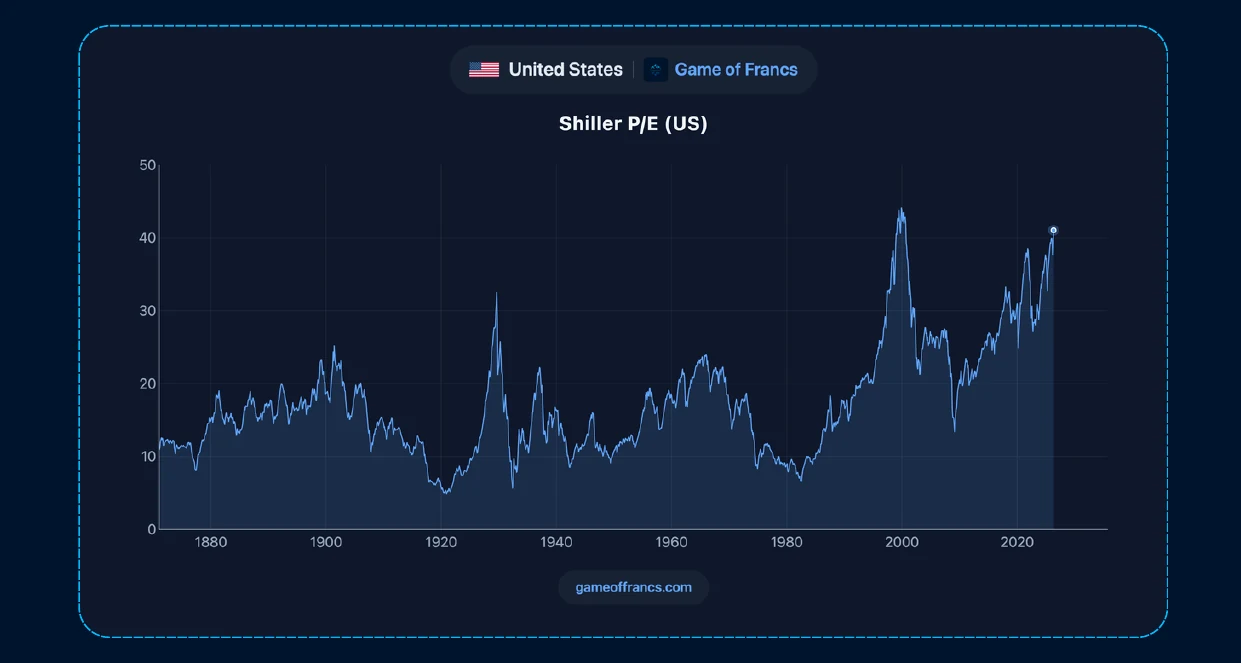
I. The Idea That Wall Street Keeps Forgetting
There is a mechanism in market economies so reliable, so well-documented, and so consistently ignored by the investors it periodically destroys, that its rediscovery in each new cycle must count as one of the more remarkable recurring phenomena in financial history.
The mechanism is the capital cycle. Its logic is elemental: high returns attract capital, capital floods an industry, supply expands, competition intensifies, returns compress, and capital eventually retreats — leaving behind overbuilt infrastructure, impaired balance sheets, and a generation of investors who paid peak prices for assets whose economics were in the process of being permanently degraded by the very capital they were committing.
This is not a controversial observation. It is, in the words of Edward Chancellor — the financial historian who has done more than any living writer to codify and disseminate the theory — simply what competitive markets do to capital over time. Supply responds to price signals. Excess returns invite imitation. Imitation creates overcapacity. Overcapacity destroys the excess returns that attracted the capital in the first place.
The cycle operated in the British railway mania of the 1840s, in the American railroad booms of the 1870s and 1890s, in the global shipping bubble of the early 2000s, in the shale oil revolution, and in the fiber optic buildout of the late 1990s. What Chancellor and Jeremy Grantham have most recently argued — in their 2026 GMO paper Valuing AI: Extreme Bubble, New Golden Era, or Both? — is that the current AI infrastructure boom exhibits every structural characteristic of the capital cycle at its most dangerous: a transformative technology, genuine productivity potential, and an investment appetite that has entirely decoupled from any sober assessment of the returns that the capital being deployed can realistically earn.
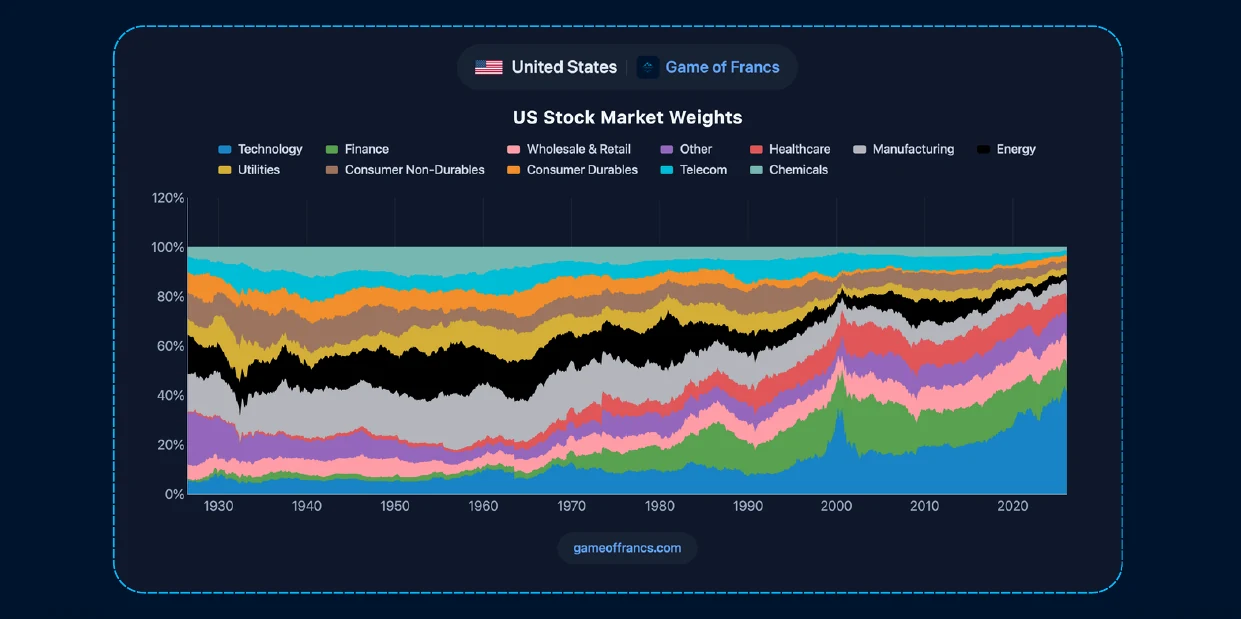
II. Chancellor's Framework: Supply Is the Signal
The theoretical foundation of the capital cycle approach is most clearly stated in Chancellor's edited volume Capital Returns (2015), a collection of investment letters from Marathon Asset Management spanning 2002–2015, with Chancellor's own analytical framework providing the conceptual spine.
The core insight is deceptively simple: most investment analysis focuses on demand. Analysts build models of earnings growth, total addressable markets, and the rate at which a product or service will be adopted. They ask: how large will this industry be, and how fast will it get there? These are not unimportant questions. But they are, in Chancellor's framework, the wrong questions if asked in isolation.
The right question is: what is capital doing? Not what profits might look like in five years if the technology performs as hoped, but what is happening to the supply of capital entering the industry today, and what will that supply do to the competitive structure and unit economics of every participant over the medium term?
History is unambiguous on this point. Industries that attract large amounts of capital reliably deliver disappointing returns to that capital — not because the technology fails or the demand fails to materialize, but because the supply of the product expands alongside the supply of capital, compressing margins and destroying the pricing power that made the industry attractive in the first place. The investors who financed the British railway network created one of the most transformative infrastructure systems in industrial history — and lost most of their money doing it. The investors who funded the fiber optic buildout of the 1990s gifted the internet age its physical foundation — and were financially obliterated when the supply of bandwidth collapsed its price by 99%.
Chancellor's framework does not require technological pessimism. It requires supply-side discipline. The question is never whether the technology will change the world. It is whether the capital attracted by that change will earn an adequate return on the quantity deployed — and history suggests the answer is almost always no.
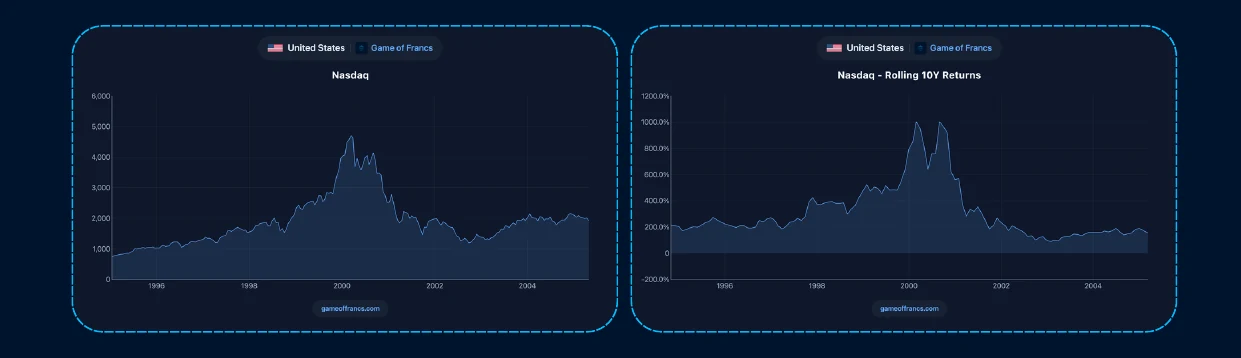
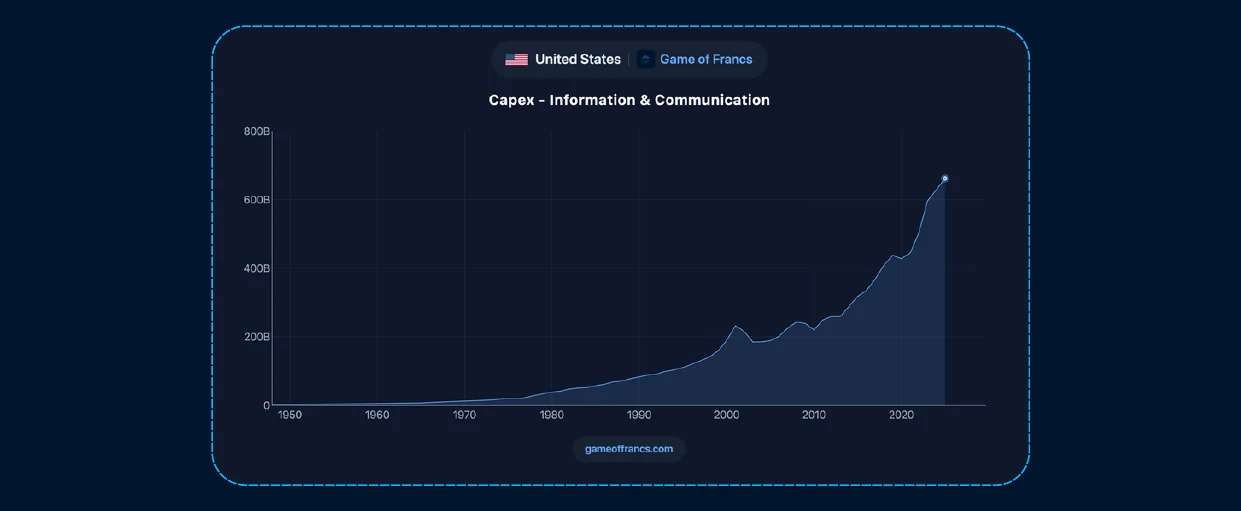
III. The AI Capex Boom: A Capital Cycle Case Study in Real Time
The numbers surrounding the current AI infrastructure buildout are, even by the standards of historical technology booms, extraordinary.
In 2025, 60% of all U.S. venture capital investments went into AI, with AI startups raising over $200 billion. OpenAI raised $40 billion in 2025 alone. Anthropic raised $16.5 billion in the same year. The hyperscalers — Microsoft, Alphabet, Amazon, and Meta — have collectively committed to data center capex programmes running into the hundreds of billions of dollars annually through the end of the decade.
These are not investments in a marginal improvement to an existing technology. They are bets on the construction of an entirely new computing infrastructure — one that requires not only the data centers themselves but the semiconductors to fill them, the electricity to power them, the cooling systems to prevent them from destroying themselves, the transmission infrastructure to connect them, and the talent to operate and improve them. Each of these supply chains is already straining.
The capital cycle framework does not require an opinion on whether artificial general intelligence will be achieved, or whether AI productivity gains will ultimately justify the investment. What it requires is a simple observation: the quantity of capital now being deployed in this sector is of a magnitude that has, in every comparable historical episode, eventually produced supply that exceeded demand — with severe consequences for the investors who funded the excess.
Chancellor and Grantham identify the specific historical analogues with characteristic precision. The railroad manias of the 19th century built genuinely transformative infrastructure and bankrupted most of the investors who financed it. The telecommunications buildout of the late 1990s laid the fiber optic cables that now carry the global internet, and destroyed roughly $2 trillion of invested capital in the process. In each case, the transformative outcome was real. The investment returns were not.
IV. The Bubble: What Chancellor and Grantham Are Actually Saying
Chancellor and Grantham's GMO paper is notable for its intellectual honesty. They do not claim that AI is a fraud or that the technology will fail to deliver on its potential. They make a more specific and more uncomfortable argument: that the current market is pricing AI assets as if the most optimistic possible scenario is not only likely but certain, while simultaneously deploying capital at a pace that guarantees the most optimistic scenario cannot deliver adequate returns to the capital financing it.
Their bubble taxonomy — Chancellor's contribution to the paper — identifies the recurring structural features that characterize speculative manias at or near their peaks. Several are present with unusual intensity in the current AI environment.
The first is narrative displacement. In every major speculative episode, a compelling story about the future replaces quantitative analysis of the present. At what price is an AI infrastructure play too expensive? The answer, in the current environment, is increasingly: there is no price too expensive, because the potential is unlimited.
The second is competitive intensity without differentiation. The defining feature of the current AI race is that every major participant is racing to deploy as much capital as fast as possible, with minimal evidence of durable competitive moats. The hyperscalers are building identical data centers to run largely interchangeable models on commoditizing hardware. The speed of capital deployment is itself eroding the competitive advantages that might have justified the capital.
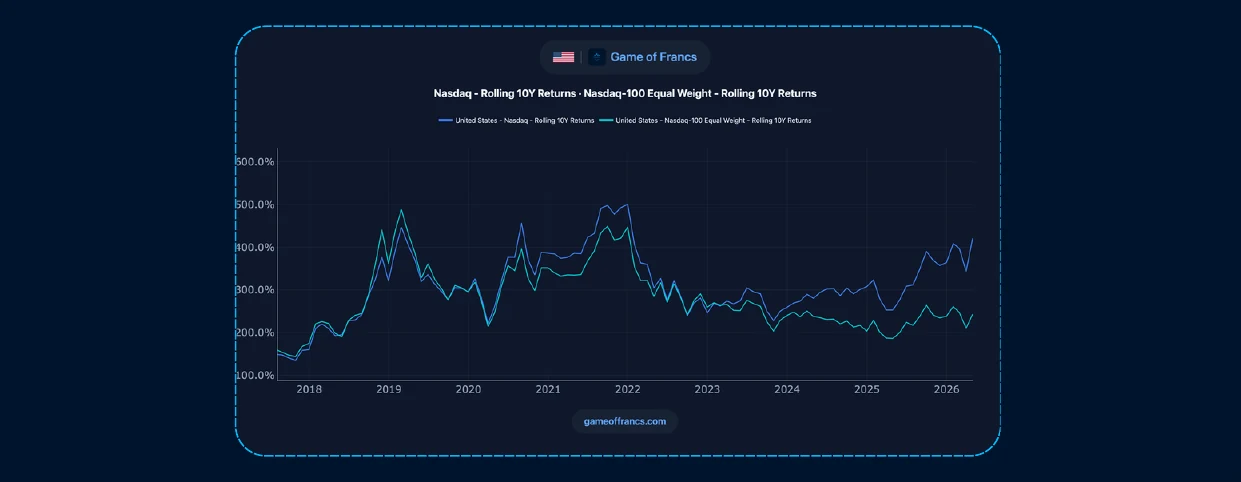
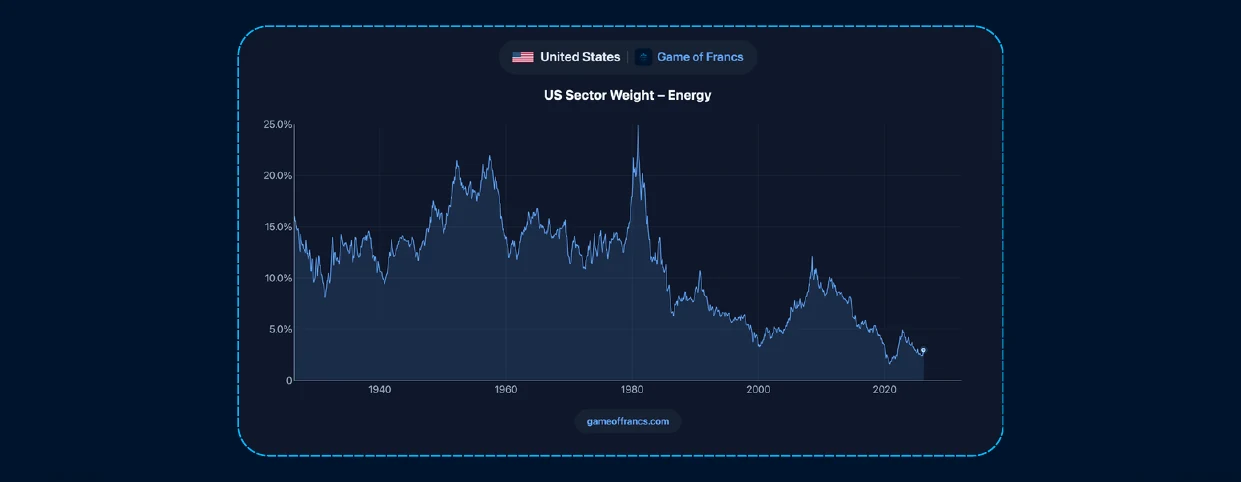
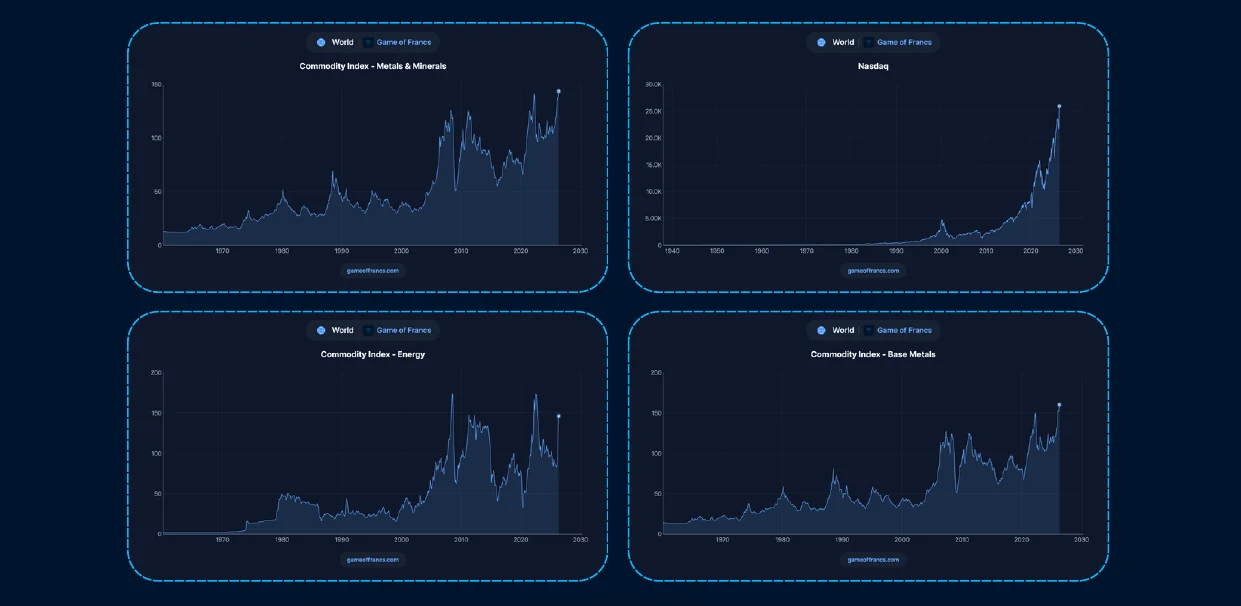
The third is crowding out. As Chancellor notes from his analysis of the dot-com era, the concentration of capital into a single sector creates opportunity elsewhere. The old economy stocks of 1999 — energy, materials, industrials — were priced at historic lows precisely because capital was flooding into technology. Today, the analogous opportunity exists in the sectors that AI enthusiasm has rendered unfashionable: commodity producers, infrastructure companies, and value-oriented international equities.
V. Margin Debt: The Accelerant in the Engine Room
The capital cycle, operating on its own, is a powerful enough force to destroy the returns of investors who commit capital near the peak of a supply expansion. What makes the current cycle structurally more dangerous than most is the financing structure through which a significant portion of the equity exposure is being held.
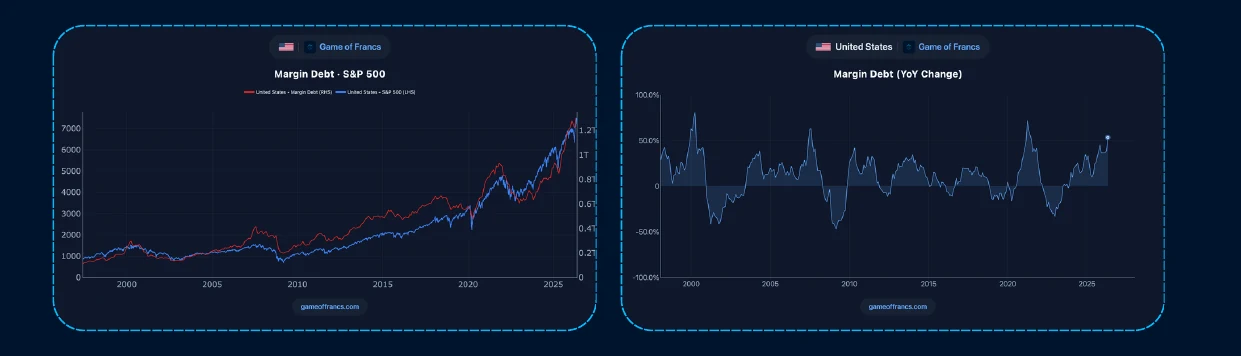
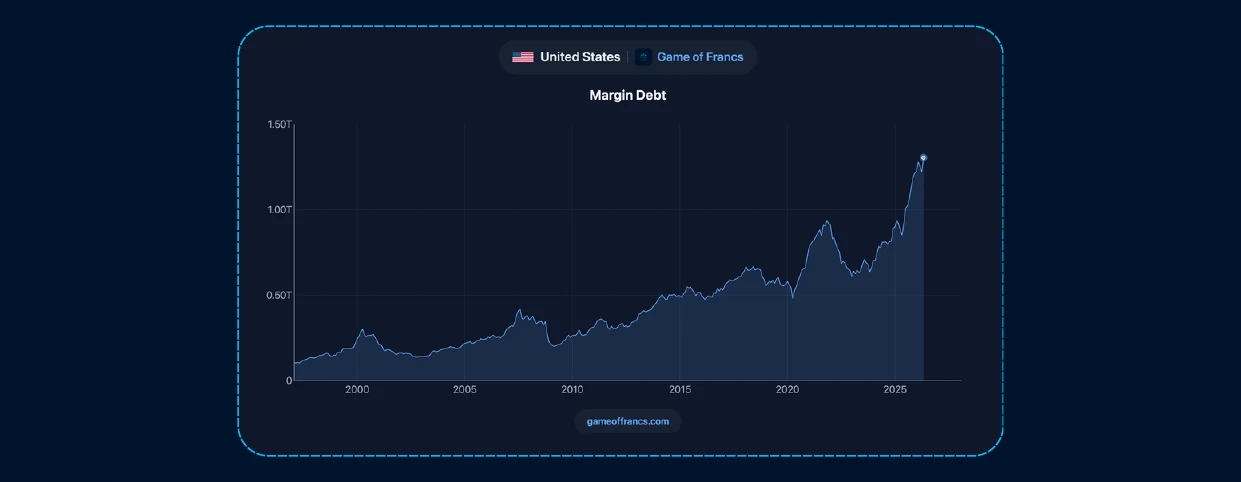
Margin debt reached a new all-time high of $1.18 trillion in October 2025, representing a 5.1% rise from September and marking the sixth consecutive monthly increase. By December 2025, it had risen for an eighth straight month, sitting at its nominal and real peak. As of that date, the investor credit balance stood at -$814 billion — the lowest level on record, meaning investors collectively owe more than they hold in cash.
These numbers require unpacking. Margin debt is borrowed money used to purchase securities. When an investor holds equities on margin, their upside is amplified — but so is their downside. More critically, their downside is bounded not by their own tolerance for loss but by the margin call: the broker's requirement that the account maintain a minimum equity ratio, triggered automatically when the value of collateral falls sufficiently.
The significance of margin debt at all-time highs is not merely that it signals optimism. It is that it creates a structural mechanism for amplifying and accelerating any decline. When prices fall, margin calls are triggered. Margin calls force liquidation. Forced liquidation drives prices lower. Lower prices trigger more margin calls. This cascade dynamic — well-documented in 1929, 2000, 2008, and the brief but violent correction of early 2020 — is not a tail risk. It is a feature of how leveraged markets function, embedded in the mathematics of borrowed money.
The year-over-year growth in margin debt recently stood at 38.7% — structurally elevated by any historical comparison. Troughs in the monthly net credit balance preceded peaks in the S&P 500 by six months in 2000, four months in 2007, four months in 2018, two months in 2021, and zero months in 2025. The lead time is compressing. The balance is at a record low.
VI. The Market Can Stay Irrational Longer Than You Can Stay Solvent
This brings us to the most important practical implication of the capital cycle framework — and the most consistently underestimated risk for investors who correctly identify the dynamics but misjudge the timeline.
The phrase is usually attributed to Keynes: markets can remain irrational longer than you can remain solvent. It is the single most important sentence in the vocabulary of contrarian investing, and it is the reason that the capital cycle framework, applied naively, is as capable of destroying its adherents as the manias it describes.
Chancellor himself addressed this directly: even with perfect foresight about the eventual outcome of a speculative episode, the path to that outcome can involve drawdowns of such magnitude that they render the correct thesis financially worthless. A short position in Nasdaq technology stocks, established in January 1999 on entirely correct fundamental grounds, would have produced losses of 100% or more before the thesis was vindicated in March 2000. Vindication arrived. The investor did not survive to enjoy it.
The capital cycle framework is therefore not a timing model. It is a valuation and risk framework — a set of lenses through which to assess the structural sustainability of returns, the degree to which current prices have incorporated future supply, and the magnitude of the correction that the cycle's mathematics will eventually demand. It tells you what will happen. It cannot tell you when.
What the combination of the capital cycle framework and the margin debt data does tell you — with considerable force — is that the current market combines the structural vulnerabilities of a late-stage capital cycle with the leverage amplification dynamics of an all-time record in borrowed money. If the correction comes gradually, margin calls may not cascade. If it comes suddenly — as corrections in highly leveraged markets historically tend to — the interaction between the cycle's fundamental dynamics and the forced liquidation cascade could produce a decline of unusual velocity and severity.
VII. What History Suggests About the Other Side
The capital cycle's destruction of returns in the investment phase is not the end of the story. It is the beginning of the next chapter — and that chapter is typically far more rewarding for investors who survive to participate in it.
The railroads that bankrupted their Victorian investors became, after restructuring and consolidation, highly profitable businesses in a permanently transformed economic landscape. The fiber optic cables that destroyed the fortunes of 1990s telecom investors became the physical backbone of the internet economy, acquired for cents on the dollar by the operators who built services on top of them. The shale producers who went bankrupt in 2015 and 2016 re-emerged as leaner, lower-cost operations that ultimately generated the sustained cash flows that the original investment thesis had promised.
In each case, the capital cycle completed its work: excess capital was destroyed, overcapacity was rationalized, and the survivors — operating with lower cost bases, reduced competition, and genuinely transformed unit economics — were able to earn the returns that the original investors had priced in but could not achieve because they funded the supply expansion that made those returns impossible.
The same logic applies to AI. The question is not whether artificial intelligence will transform productivity, create new industries, and deliver significant economic value. It will. The question is who will capture that value, and at what cost. History strongly suggests the answer is: not primarily the investors who funded the buildout, but those who acquire the assets and capabilities after the cycle completes its correction — at prices that actually justify the risk.
Chancellor's framework, applied consistently, points toward the sectors and geographies that today's capital cycle has depressed: energy infrastructure, industrial commodities, and international value equities — the old economy stocks of today's technology cycle — trading at discounts that reflect sentiment, not fundamentals.
VIII. Where the Opportunity Actually Is
The capital cycle's crowding-out effect is not merely a theoretical construct. It produces real and measurable mispricings in the sectors that capital has abandoned in its rush toward the favored theme of the moment.
Energy infrastructure is the most compelling current example. The physical reality of the AI buildout — the power demand alone from data centers is projected to double or triple by 2030 — requires exactly the kind of generation capacity, transmission infrastructure, and grid investment that equity markets have systematically undervalued. The companies building the physical substrate that AI requires are priced as legacy businesses. They are, in fact, the critical infrastructure of the next decade.
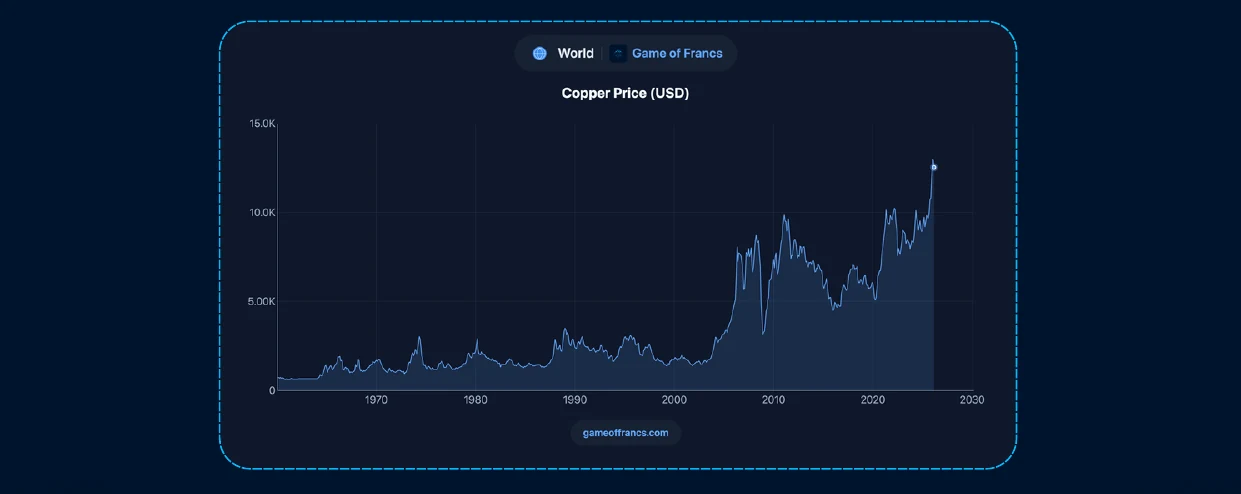
Industrial commodities — copper above all — face a structural supply deficit that the capital cycle has, paradoxically, helped create. A decade of underinvestment in new mining capacity, driven by the poor returns of the prior commodity cycle, has left the global copper industry structurally short of the output that the energy transition and the AI buildout simultaneously demand. The capital cycle that destroyed commodity investors in 2015 has set up the conditions for the next commodity supercycle.
International value equities — European industrials, Japanese manufacturers, emerging market commodity producers — trade at valuation discounts to U.S. growth equities that are, by most measures, at historic extremes. These discounts reflect the concentration of global capital flows into U.S. technology assets and the resulting neglect of every other geography and sector. They will not persist indefinitely. Capital cycles correct on both sides: the overcrowded sector eventually disappoints, and the neglected sector eventually surprises.
The appropriate portfolio response to this analysis is not aggression. It is reorientation — away from the sectors where the capital cycle's mathematics are working against the investor, and toward those where they are working in their favour.
IX. The Honest Risk Assessment
An honest application of Chancellor's framework requires acknowledging the risks that cut against the contrarian position as clearly as those that support it.
The most important is the possibility that AI represents a genuinely discontinuous technological shift — one that breaks the historical pattern by delivering productivity gains large enough and fast enough to justify the capital being invested. This is the scenario that the market is pricing. It is not impossible. The historical analogues Chancellor cites all involved technologies that were transformative; none of them involved technologies with the potential theoretical scope of artificial general intelligence.
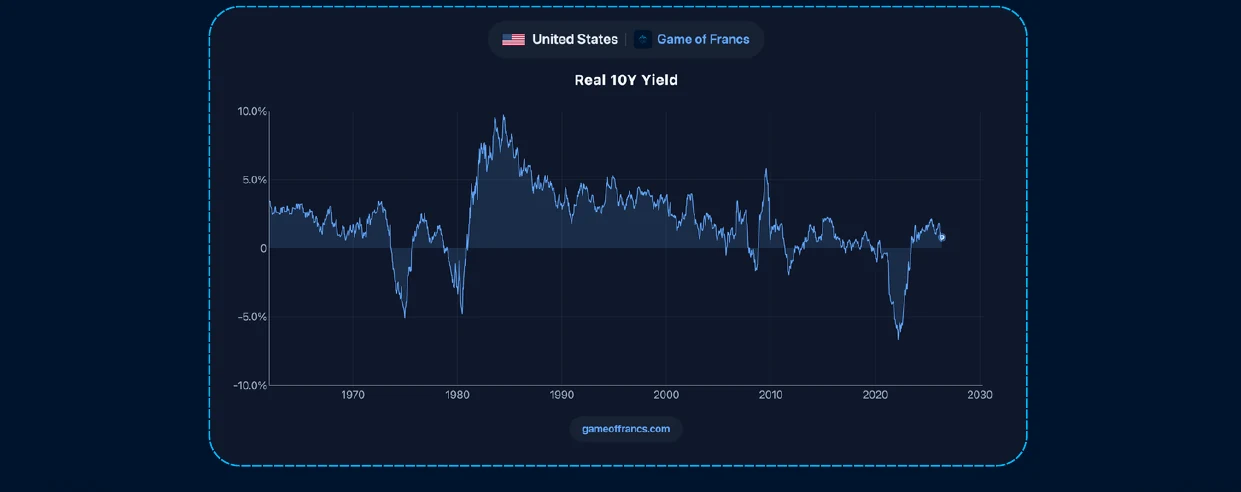
The second risk is monetary. A decade of suppressed interest rates and quantitative easing has fundamentally altered the cost of capital in ways that make historical valuation comparisons harder to apply. If the structural level of real interest rates remains lower than historical norms — whether through central bank policy or structural demand for safe assets — the valuation multiples that appear extreme by historical standards may be more sustainable than they appear.
The third risk is timing, and it is the one that has destroyed more correct contrarian theses than any fundamental error. The capital cycle framework predicts the direction of returns, not their timing. Markets powered by record leverage, institutional momentum, and a genuinely compelling narrative can remain elevated for years after the point at which fundamental analysis suggests they should correct.
None of these risks invalidates the capital cycle framework. They are reasons for humility about timing and for caution about leverage in the contrarian position — not reasons to ignore the structural dynamics that Chancellor has spent a career documenting. The margin debt data, in particular, suggests that the market's capacity to absorb a shock without cascading forced selling is lower today than at almost any prior point in the data series. That is a risk premium that is not being charged.
X. Conclusion: The Cycle Always Completes
The capital cycle is not a moral judgment. It does not punish greed or reward caution. It is a mechanical process — the response of competitive markets to price signals, mediated by the behaviour of capital that seeks returns and creates, in seeking them, the conditions for their destruction.
What Chancellor has done, across three decades of writing and investment practice, is to make this mechanism visible — to give investors a framework for identifying, in real time, the structural dynamics that will eventually determine whether the capital being deployed today will earn adequate returns or be destroyed in the process of creating the abundance that eliminates them.
The current AI infrastructure cycle is the clearest and most legible expression of capital cycle dynamics since the telecommunications boom of the late 1990s. The technology is real. The transformation is genuine. The capital is excessive — not in the sense that any specific data center is unnecessary, but in the aggregate sense that the total quantity of capital now committed to the sector exceeds what its eventual competitive structure can sustain.
Layered on top of this structural dynamic is a leverage position — expressed in all-time record margin debt, a credit balance at record lows, and a year-over-year growth rate in borrowed investment money that sits well above its historical average — that creates the conditions for a violent and rapid correction when sentiment shifts.
Get the next article by email
One email when a new piece is published. Nothing else, and one-click unsubscribe from any message.